
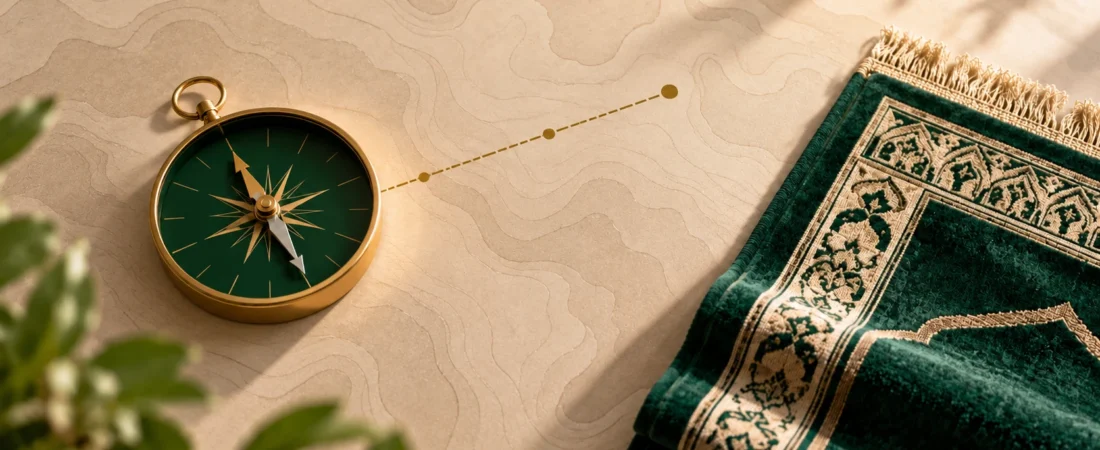
What the qiblah is, why Muslims face the Ka'bah in prayer, and how to find the direction.
AI-generated English narration.
The qiblah is the direction Muslims face in prayer — toward the Ka’bah in Makkah. It is not the object of worship itself; it is a shared direction that unites Muslims praying anywhere in the world, facing a single point. The command to face it is stated directly in the Qur’an: “So turn your face toward al-Masjid al-Haram. And wherever you are, turn your faces toward it” (2:144).
Before this instruction, the early Muslim community in Madinah prayed facing Jerusalem for a period; the qiblah was then changed to Makkah, and it has remained so ever since. Today, mosques are built with a wall (the qiblah wall) marking this direction, usually indicated by a small niche called the mihrab at the front of the prayer hall — so inside a mosque, finding the qiblah is simply a matter of facing the same direction as everyone else.
Outside a mosque, the qiblah can be found using a compass, a qiblah-finder app, or by asking; most Muslim-majority cities have it clearly known, and many hotel rooms in such cities mark it on the ceiling or in a drawer. Precision matters less than sincere effort: a person who prays facing a reasonably correct direction, having genuinely tried to determine it, is not required to have found the exact geometric bearing to the degree.
If you later realise mid-prayer that you were facing the wrong direction, you simply turn to face the correct one and continue — the prayer is not invalidated by an honest mistake in direction, only by knowingly praying in a direction you knew to be wrong. Like several of the small practical questions new Muslims often have, this is a good one to ask a local imam or knowledgeable Muslim directly if it comes up in your own situation.
Key points
- The qiblah is the direction of prayer, toward the Ka'bah in Makkah — a shared direction, not an object of worship.
- The Qur'an commands facing al-Masjid al-Haram in prayer, after an earlier period of praying toward Jerusalem.
- Mosques mark the qiblah with a wall and mihrab; elsewhere it can be found with a compass, an app, or by asking.
- An honest mistake in direction, sincerely tried, does not invalidate the prayer — only knowingly praying the wrong way does.
Qur’an
“We have certainly seen the turning of your face, [O Muhammad], toward the heaven, and We will surely turn you to a qiblah with which you will be pleased. So turn your face toward al-Masjid al-Haram. And wherever you [believers] are, turn your faces toward it [in prayer]. Indeed, those who have been given the Scripture well know that it is the truth from their Lord. And Allah is not unaware of what they do.”
Surah Al-Baqarah (2) — 2:144
Scholarly notes
Precise methods for calculating the qiblah direction (great-circle vs. other projections) can give very slightly different bearings in some locations; this is a technical, not theological, difference and does not affect the validity of prayer performed with sincere effort.
Report a correction. HikmahBridge is an educational resource, not a replacement for a qualified scholar or teacher.
Lesson 4 of 17 in How to Pray