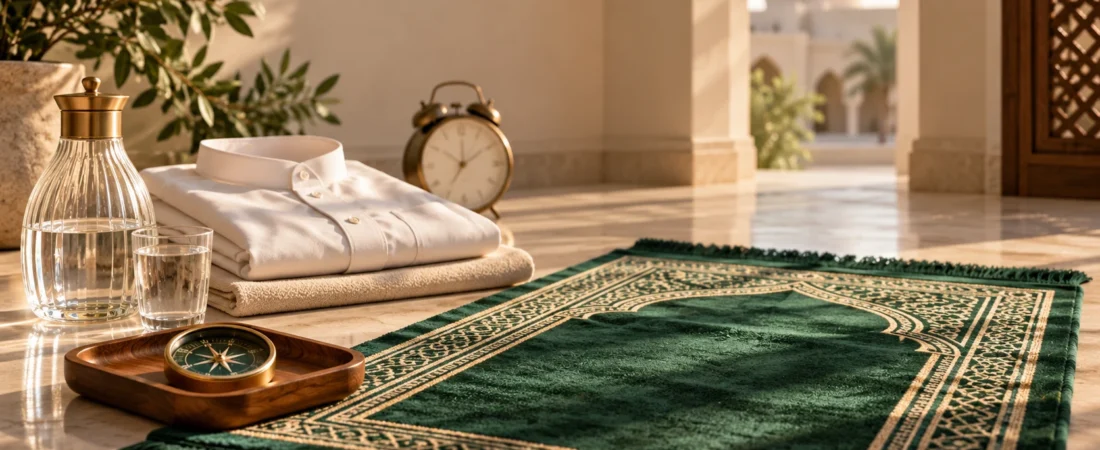
The conditions that must be met before Salah is valid: purification, clothing, awrah, Qiblah, timing and intention.
AI-generated English narration.
Before Salah can be valid, a number of conditions need to be met. These are widely agreed upon across the major schools of Islamic law (madhhabs), though some of the details within them are matters of scholarly difference.
- Purification (Taharah) — being free of major and minor ritual impurity, normally achieved through Wudu (or Ghusl after major impurity).
- Clean clothing and place — the clothes worn and the immediate place of prayer should be free of impurity.
- Covering the Awrah — covering the parts of the body that must be covered in prayer. The exact boundaries differ between men and women and are discussed differently across the schools of thought; consult a local teacher or scholar for precise guidance.
- Facing the Qiblah — facing the direction of the Ka’bah in Makkah.
- Entering the prayer time — each of the five prayers has its own valid time window; praying before that window begins does not fulfil the obligation.
- Intention (Niyyah) — intending in the heart to perform that specific prayer. This does not need to be spoken aloud.
The next two lessons cover Wudu — the most commonly needed form of purification — in detail.
Key points
- Salah has several conditions that must be met before it is valid: purification, clean clothing/place, covering the awrah, facing the Qiblah, being within the prayer's time, and intention.
- Most of these conditions are agreed upon across the major schools of Islamic law.
- The exact boundaries of the awrah differ between men and women and between schools of thought.
- Intention (niyyah) is made in the heart and does not need to be spoken aloud.
Scholarly notes
The exact boundaries of the awrah (what must be covered) are discussed differently across the major schools of Islamic law. This page gives the general principle; for precise, situation-specific guidance, consult a qualified local scholar or teacher.
Report a correction. HikmahBridge is an educational resource, not a replacement for a qualified scholar or teacher.
Lesson 3 of 17 in How to Pray